Showing posts with label Photography. Show all posts

Wednesday, May 2, 2007

Do Ethics Exist in Photojournalism?

The ideal situation for journalists would to be totally independent and non-partisan and just record and report the news.

In the real world that almost never happens.

One of my first jobs I was reminded by the editor-in-chief that a newspapers was a business and the our number one job was to sell newspapers. My idealistic view of the journalists being integral to a free society, the fourth estate, freedom of speech, voice of the people, was shattered.

How do the demands of fair and balanced reporting relate to the business side of selling newspapers? There is supposed to be this imaginary wall dividing the editorial side and the business side of things in journalism. The problem is the wall is like the emperor's new clothes, and not all that well built.

I have worked at small, medium and large newspapers. The one thing I was never handed was any thing relating to ethics. Nothing on what you could do or not do. Actually, I never held a job where ethics were spelled out. What are the rules? Are there no rules?

There is a telling scene in the first episode of "The Sopranos" this season. Tony Soprano, his sister and brother-in-law are playing Monopoly. All of sudden new rules are implemented. Tony's brother-in-law objects, citing the official rules in his protest, but to no avail. I remember the exact same thing happening when I was in the fourth grade. My friend made up the rules as we went along, eventually I learned what the rules were. I have had similar experiences in journalism.

One of the first rules of a newsphotographer is that you never manipulate people for photos. You are supposed to capture what is in front of you and by doing so, have truthful images. When I was a young teenage photographer shooting for my college student newspaper, "The Spectrum" in Buffalo, NY, that's what I did. I was so shy I couldn't do anything else. I didn't know how to direct someone to do something to make a photograph more interesting.

Then one day I covered an event that the mainstream press covered. The veteran newspaper photographer who showed up probably didn't even know I existed. He staged and directed people and was in and out of the event in no time. Was he unethical? His boss wouldn't have thought so. This is how things were done. And in most cases still done at big and small newspapers and other news organizations across the country. I have seen it first hand.

The second rule is that you don't manipulate the image after the fact. You know, photoshop it. It's funny that a software program is now a verb in the mainstream.

Back in the day of no computers, we made black and white prints. We darkened and lightened selected areas of the print in the darkroom. We rubbed ear wax on the negative to get rid of scratches. We used bleach to whiten someone's eyes or open up shadows.

Some photographers went a little too far. They had hockey pucks and balls that could be placed in a photo. They combined negatives. They darkened areas from pure white to pure black. It was called "hand of God" printing. The practice not only was accepted, it was encouraged, many award-winning photo used its methods.

Photographers tried to grandfather techniques from the old days, stating that Photoshop could only be used to replicate a darkroom print. Really?

It's pretty easy to change a photograph. Clone out something. Add something. A photographer who grew up learning from the veteran shooters who rules were that they were no rules, not only be tempted to change things radically to make a perfect photo, it would be like leaving the cars to the Porsche on the kitchen counter while you left on a two week vacation with your teenagers in charge. Wanna bet the Porsche has some uneven wear on the tires when you come back?

This is a typical day for a working photographer on a small to mid-size newspaper. Four to six assignments ranging from a feature portrait, a sporting event, a craft fair and a couple shots of features of people doing stuff that can be used anywhere in the newspaper. Some newspapers call it "wild art", enterprise feature, a standalone, and I even heard the term "rope" a take on the acronym ROP which means run of press. Pretty boring stuff. From this you have to make photos that make readers want to read the stories. For a photographer you also want to make photos that will be in your portfolio so you can land that bigger and hopefully higher paying job.

My first full-time job paid $280 a week. I worked 6 days a week and 14 hours a day. The minimum wage at the time was $4.00 an hour. The newspaper did not pay overtime. So basically the guy at the local fast-food joint was making more money and he didn't have to own expensive camera equipment, drive his own car or have a college degree. I had to fill a whole newspaper with photos. Front page, sports page, feature pages, local pages, special sections, a couple of photo pages a week, plus process and print all the reporters photos, and make prints for the public who saw their photo in the newspaper and wanted copies. Oh and by the way I was also in charge of ordering photo supplies, fixing and maintaining all photo equipment and trouble shooting the computer equipment at the newspaper.

With all that on tap, do you think ethics was a topic of discussion in the newsroom. Most reporters had a bottle of booze in their desk drawer and you couldn't see the other end of the newsroom because of the haze from cigarette smoke. That was 20 years ago. Okay, they banned drinking and smoking in the newsroom, but have things really changed? I know of one reporter who works out of a bar to circumvent the drinking and smoking rules. Ethics? This guy works out of a bar, so I guess bar rules apply.

There are some great photographers who have the backing of there news organization to put in the long hours to document incredible story-telling photos. Unfortunately with the down-sizing of newspapers and other new gathering operations, that has become a luxury. It's very difficult and expensive to cover stories that are important. The pressure to get those same photos in a few hours or minutes that should take days or months has lead to questionable means to get them.

Editors never ask how? They ask why not? Like, why did you not get that shot? The other newspaper has it. Why is that photo so boring? They never ask, did you manipulate the subject to get that great photo? It's the don't ask, don't tell policy. Editors don't really want to know.

Here is some of the answers they would get from some photographers if they were given truth serum.

  • I drove two hours looking for a feature and I saw these kids playing and they stopped when I got out of the car so I told them to redo the thing so I could get a photo. The last time I didn't get the feature, you yelled at me so I took things into my own hands.

  • I had two minutes for the photo and I missed the distracting thing in the background so I cloned it out.

  • I was told to get a picture of holiday traffic, but I couldn't find any so I used a long lens to make it look a lot worse that it really was.

  • The only place there was flooding was in this one area so I went there and got a low angle to make it more dramatic, plus the story was on how bad the flooding was.

  • I was late for the event with all the other assignments, so I had them re-create the event.

You get the idea.

So why are ethics important? A news photograph represents truth. Do you want a lie? Are you happy to pay for a premium product and to later find out it's a knock-off, a fake? The box shows a photograph of a mouth-watering steak dinner, inside it's a frozen mass of brown. Mission Accomplished? Jessica Lynch a hero? We make life changing decisions based on photos. The photo of that cute person you met online, it has been retouched. That beautiful house you saw on the internet, they didn't show you the termites in the basement? The elected official doing....oh forget it, it was a photo-op. Jaded, cynical? Men didn't land on the moon? The Holocaust didn't happen? Every photo is a fake? What and whom are we to believe?

Monday, March 26, 2007

The $1.5 million Cra$h


Irwindale, CA - Actor Eddie Griffin took a very expensive ride when he totaled a $1.5 million Enzo Ferrari at the Irwindale Speedway on Monday night.

Griffin was lucky he was able to walk away. Both airbags deployed and unlike other celebrities that were driving exotic cars around the race track, he wasn't wearing a helmet.

The event was to promote "Redline the Movie" which is opening nationwide on April 13th. The spectacular crash did make a dramatic impact, but I don't think the owner of the Enzo, Daniel Sadek, who wrote and produced the movie, had that in mind.

I got a sequence of photos of the Enzo hitting a concrete barrier and anyone who wants to buy a license for the photos can contact my photo agency, Landov in NYC.

The only reason I even came to the event because I really wanted some photos that were a little different and thought celebs and exotic cars would be a good mix. When Griffin took a couple of practice laps before the crash, I knew something might happen as he knocked over quite a few orange traffic cones that were laid out on the track.

My first reaction was shock. I knew he was in trouble right before the crash and held down the button on my camera and my newly purchased Canon 28-300mm lens. Later when I reviewed the photos on the LCD on the back of my camera, I was relieved that I actually captured the sequence. When something like this happens, you wonder if you mind and body actually coordinated together to take the photos.

I left immediately left the track to try to make sales of the photograph to publications on the East Coast. If Annie Nicole Smith autopsy report wasn't released on Monday, the papers could of found space for the photos, but their news hole was tight and it was too late. Hopefully publications in Europe will want the photos. Eddie Griffin isn't an A-lister but the last time an Enzo was wrecked on California's PCH in Malibu, it was a world-wide story.

You can see a video of the crash here.

Saturday, March 24, 2007

Perez meets Paris


West Hollywood - The internet is the great equalizer. In the past there were hurdles and gatekeepers for most people to have their words and photos published. Not anymore.

A once obscure blogger named Mario Lavandeira, Jr. has a website called PerezHilton.com. That site has garnered a lot of attention lately and according to him has had traffic in excess of 4 million visitors in a day.

His website is so popular that even the celebrities he writes about came to his 29th birthday party he hosted at the Roxy in West Hollywood on Friday. Perez Hilton is an obvious play on Paris Hilton's name. Both Paris and Perez were at the party, which is kind of ironic considering they both attained fame via the internet.

Paris was not the only bold-faced guest. John Stamos, Dave Navarro, Dita Von Teese, Kelly Osbourne and Amy Winehouse showed up too. That is a testament of the power of his blog.

This party wasn't for Perez's fans. It was a media event where sponsors advertised their goods and publicists tried to push their clients into the limelight. It may have been called a party, but in reality it was work for most of the attendees.

Usually a party with Paris Hilton's name would attract more than a handful of photographers that were at the red carpet on Friday night. What made many photographers basically boycott the event was the fact that Perez Hilton uses many photographs on his blog without attribution or payment. All in the name of fair use. He has even used my Britney Spears photos. A lot of bloggers are using photos that they haven't purchased any rights to.

Well it's one thing when a blogger uses art to illustrate a story that they are writing about. Perez Hilton is not any old blogger. He is profiting significantly from his blog. Paid national ads for movies are regularly on his blog. Consider that the average cable news show gets less than a million viewers a segment, PerezHilton.com actually gets more eyeballs. But the mainstream media outlets actually pay for their content. If CNN wants to use my photos, they better be paying me.

A segment on the "View" discussed Perez Hilton's website. One of the hosts mentioned that Perez gets paid in excess of a million dollars a year. I'm not to sure of that, but I think he has the money to pay for photos. Perez was paid for appearing on the cable drama "Dirt", playing himself. Could you imagine if they used his likeness or website on the show without compensating him? He wouldn't be too happy.

So if Perez is exploiting photographers, why cover his event? I'm a journalist first, and you can't report on something without first hand knowledge. I might have some bias about him because he has used my photos, but in the larger scheme of things, he is a story and a story worth covering.

The LA Times reported about how photo agencies are suing Perez.

Thursday, March 22, 2007

The Environmental Portrait


One mainstay of editorial photography is the environmental portrait. A writer is assigned a story and after doing some reporting, they contact the photo editor to set up a time for a photographer to take a photo of the subject. You seen the results a million times in newspapers and magazines.

It's not really a news photo. What the writer has written about on the subject has happened a while ago and you, the photographer are there to illustrate the story. Sometimes you are given some kind of back story from the editor, sometimes not.

I received an assignment this week to take a portrait of women that runs a non-profit center that is helping people who have been enslaved by nefarious traffickers in the U.S. It's hard to imagine that slavery in America still exists, but it does, often exploiting illegal aliens.

Part two of the assignment was to take a photo of a women who was enslaved. The publication stated in their assignment request was that they wanted to have "Maria", the former slave, photographed outdoors in the neighborhood, showing off the area. They wanted a photo of the director, but "closer on the face".

A pretty interesting story, for the writer at least, but I have to create something that already happened and that will satisfy the layout of the publication and website.

When I arrived at the job, my first priority was to get a decent photo of the director that had a clean background with some nice lighting. She told me that she didn't want to reveal the location of where she lived and a photo of "Maria" shouldn't show any landmarks either. Part of shooting a environmental portrait is to show something that links the subject. So now I had to show something, but not too much.

I asked the director if she had a home office from where she worked from. She said she worked form the dining room with her laptop. I was hoping she had an office that may had artwork or signage that could be used. Her dining room wasn't bad. It had a nice wall that could be used as a clean background, a table and laptop with a bouquet of flowers that was used in the photo.

One of the first thing I ask my subject is what kind of time frame are we dealing with? Do they have some other appointment they have to go to next? She had to leave for work in less than an hour, and "Maria" wasn't there yet, but on the way. So I had to work fast.

The day before I thought about the assignment and decided that I wanted to be very mobile and not bogged down with too much equipment. I have a case with battery operated strobes that I use for that along with some light stands and a backpack with two cameras and two lenses, my 24-105 zoom and 50mm f1.4 lenses.

Battery operated strobes are great when shooting outside. My case includes a Norman 400b, 3 Vivitar 283's and a set of PocketWizards radio slaves. I have a mini 19 inch octo-type light modifier by Norman that fits on the 400b that gives out a beauty-dish light. It works like a shoot-thru umbrella with a diffusing panel on it.

When shooting a portrait I try to balance the really complicated lighting schemes with simpler ones where the subject is more important than the technique. This time I wanted simple lighting that looked good but was worry free and allowed me to focus on the subject.

The first subject was easy. Director with office-like setting, hint of laptop, some flowers in foreground, splash of light in background wall for interest.

"Maria" was a little more complicated. How do you show someone that has been enslaved? The publication wanted outside shots. I could of made some cheesy photos entailing bars or fencing. I wanted something more subtle. I noticed a wall of hedging across the street. I thought that would make a clean background and symbolize a barrier. Luckily it was an overcast day in Southern California making my strobes the principal lighting for the photograph.

What really made the photo was "Maria". Her face belied a history of rough times and more trying times to come. It was just me and the subject on the street with one light. No assistants. No writer. Sometimes simple is best.

For a link to the story on "Maria" click here.

Sunday, March 18, 2007

Making the Best in Bad Light

This weekend I was assigned to shoot high school basketball. It doesn't have the glamor of the NBA, but it is less restrictive and you are more likely to get a great photo than from a pro game.

The first thing was to plan on what gear to bring. I usually bring a couple of camera bodies with a 70-200mm 2.8 lens, 16-35mm 2.8 zoom and my 300mm f2.8 lens and call it a day. But that's for a professional or major college team in a well-lit arena. High school is a different manner. Most high school games are played in dark dingy gyms. So my first thought was to bring in some portable strobes with wireless pocket wizards to trigger them.

Then I realized since this was a regional final game to played at Cal State Fullerton, a college gym, I didn't think I needed to bring in additional lighting. I needed just a few action photos and some reaction photos of players either celebrating or sitting on the bench in dejection if they lose.

I brought a couple of fast primes, my 50mm f1.4 and my 85mm f1.8 lens just in case the light was bad.

The first thing I realized when I stepped into the gym was that it was dark. Very dark. At that point I second guessed not bringing in some strobes. My camera exposure said f1.8 at 1/500th of second at iso 1600 under the basket. You need to shoot at least 1/500th of second to stop basketball action and iso 1600 is the highest my camera will shoot at, the 3200 setting is unusable. The 1600 setting is really pushing it.

For reaction shots 1/250th second shutter speed would be okay with my f2.8 lenses. So I decided my 16-35mm and 70-200mm lenses would be for post-game shots. And try to get some action on the 85mm f1.8 lens during the game.

I noticed there was an area high up on the second level where I could also take some photos. Might as well walk around the gym and try to get some different angles, something that isn't allowed in an NBA game. Shooting overhead also allows you to shoot with a better exposure as the light is reflected directly back to you, giving you about a 1/3 stop of light. So why not?

Both the teams I was covering lost, giving me only the opportunity to shoot photos of crying kids at the end. Emotions run very high during a high school play-off game, another thing you won't typically get during an NBA game.

In the end, my client got a range of photos in different shapes to fit their layouts and made a very short deadline. I got them photos in less than ten minutes after the game ended.

Wednesday, February 28, 2007

Oscar Wrap-up

This year's Academy Awards was the return of Old-Skool.

It was the anti-American Idol. The public doesn't vote, the clubby Academy votes. Instead of trying to get any younger viewers, it went straight for the middle-aged core audience. And the big winner was the sixty-four year old Martin Scorsese. The only bright spot was American Idol cast-off Jennifer Hudson, who looked very out of place.

The Red Carpet, as usual was chaos. The big problem was that some of Hollywood's biggest stars didn't bother walking the Red Carpet because of the danger of bumping into an old flame. Ben Affleck didn't want to be seen in any photos with Jennifer Lopez. Tom Cruise wanted to avoid Penelope Cruz and Nicole Kidman. Publicists had to make sure that Jennifer Biel and Cameron Diaz, both who dated Justin Timberlake, didn't have a cat fight. Kidman walked the red carpet with a pregnant Naomi Watts, shedding their significant others.

This was supposedly a "green" awards show. I did not see any evidence of that. No carpeting made of recycled materials. The limos burnt gas. No solar powered Klieg ligts. If anything it only pushed the stereotype of Hollywood being an out-of-touch radical left-wing crazed cabal.
You had the openly gay Ellen DeGeneres hosting the show. The "married" Melissa Etheridge winning the best song. Vice-President Al Gore got the loudest applause when an "Inconvenient Truth" won best documentary. Prius driving Leonardo DiCarprio, Cameron Diaz and Larry David were in full force, not to mention the king of conservation, Ed Begley Jr. You come to an Awards Show and the Democratic National Convention broke out.

Hey, I'm a liberal who grew up in New York, but do we really have to wear our politics on our tuxs? Let's save it for the Global Green Awards party.

It's always fun when to watch what Hollywood actors, most of whom live inside a bubble of yes people, think of what to wear to basically the ultimate fashion show, the Oscars. I think some people come to the Oscars just so they can get their photograph into a magazine's worst dressed list. Sally Kirkland wears the most hideous things every year. Jennifer Hudson got Vogue magazine editor-at-large Leon Talley to pick out a dress. Big mistake on the weird Star Trek inspired shrug. Meryl Streep and Faye Dunaway have let their subscriptions to fashion magazines lapse. I'm no fashion expert, using instead as my rule of thumb "the what were they thinking" acid test.

For any photographer covering the Oscars, it truly a day that never ends.

I got up at around 9:00 a.m. at the Roosevelt Hotel. I went through an equipment check, made a few phone calls to my editors, and then walked down to the Kodak Theater to check the strobes in the press room. From 11:00 a.m. to 2 p.m. the press room is closed for a security sweep, so if you want to check your lights you have to be there at around 10:30 a.m. After the lighting check I went to meet my runners who would be walking my digital cards from my spot on the red carpet to the hotel room where an editor was stationed.

I gave them a tour of the complex and told them the ground rules. Runners can't take photos, can't loiter and watch, and had to stay within a marked path. They do have a pass that give them access to all the regular media areas, which is great.

Around noon I walked a couple of blocks to get a quick lunch at a local fast food joint and then back to the Red Carpet where I tried to make a few feature photos before the big event. That lasts until about 2 p.m. From 2 until 5:30 the stars walk the red carpet. The last hour is non-stop shooting. I burnt up one flash, which I quickly replaced with a back-up, and went through a couple of Turbo batteries. After about 2,000 shots and 10 digital cards with a half-dozen trips by a messenger to an editor, the Red Carpet was done.

Part 2 was the Awards Room, where the winners and some presenters go back and get their photo taken. They changed things this year and only announced the big winners in the last hour of the show. That meant waiting around and shooting meaningless photos of obscure categories winners for 3 hours until someone the magazines cared about showed up.

Around 10 p.m. I started packing up all my equipment and headed back to the hotel for some editing. My editor pumped out around 300 photos while I was shooting. I then spent the next nine hours pushing out another 500 or so photos. I was up for 23 hours, slept for 3 hours and then drove home. Until next September, Awards Season is officially over.

Thursday, February 22, 2007

Getty Buys Wireimage: An Analysis

Today, Getty Images announced that they are buying the celebrity photo agency Wireimage for $202 million.

The rumors about Wireimage selling out has been around for a while. Mediavast, the parent company of Wireimage, is made up investors who raised many rounds of venture capital to create a large entertainment and sports photo agency. The conventional thinking was that the investors would finally realize a profit by cashing in.

How much profit will the founders of Wireimage get? $202 million sounds like a lot of money to split up 8-10 ways. But first they have to pay off the money they borrowed to get the company off the ground.

There was talk of Wireimage filing for chapter 11 bankruptcy. Was that the motivation for Wireimage to finally sell out to their rival? And if Wireimage was doing so well in the business why would they sell?

The Wireimage photo credit and its sister service, Film Magic, dominate magazines. The only problem is that doesn't mean you are making money. Wireimage had a very high overhead. Over 200 employees, offices in New York, Los Angeles, Las Vegas, Atlanta, Miami, London, Sydney, Tokyo, Germany, Spain, The Netherlands and even Shanghai. Add to that expensive band-width and computer server costs.

Wireimage was known to gain market share by heavily discounting the price of photos. You have to sell a lot of photos at discount prices to recoup the high overhead. All in a time period where publications are retrenching, not expanding.

With all the focus on celebrity magazines, the irony is that the celebrity photo business is very fragile. There are many forces that are putting pressure on photo agencies. First and foremost is the internet. Why wait around for your favorite magazine to publish when you can read about it online today? Photo prices for the web are half to one-third of print prices. And that's if people actually download and pay for the photos, most celebrity bloggers are stealing photos.

Wireimage core business was shooting celebrities at official red carpet events that are star-friendly. The public likes those photos but has even a greater appetite for street photography of celebs, which the paparazzi have fulfilled. More and more of celebrity driven magazines and even mainstream media are using photos from the paparazzi. Which photo will drive more newsstand sales, Britney Spears shaving her head or Britney on the red carpet? The public votes everyday with web traffic.

What is Getty getting out of the deal? The elimination of their largest competitor, like Microsoft buying Apple. Wireimage has been a thorn in Getty's side for the past few years as they both bid on league contracts for major sports like the NFL and PGA Golf tours. Now they can own that market.

Getty has similar problems as Wireimage. They too have a high overhead and the added pressure of being a publicly traded company who shareholders demand profits. Most of their profits have come from licensing commercial images for advertising use. Their editorial side of things has a lot of prestige but doesn't generate the same revenue. Editorial prices for images have been on a downward spiral. Buying Wireimage, which is basically an editorial service, is an attempt to shore up Getty's weakness.

I don't think Getty really will increase their market share significantly to make up for the price they paid. Magazines like to have an array of photos from different agencies. They are not going to put out a publication full of photos from one agency, otherwise they lose any exclusivity factor. Why buy People when US Weekly has the same photos?

Most photo agencies will look at this buyout as an opportunity to fill a large void that Wireimage has left. The only problem is that for now, it will be Getty and a lot of niche players.

Wednesday, February 21, 2007

Rolling out the Red Carpet


Los Angeles - When the Academy rolls out their Red Carpet, it's the big one.

Hollywood Blvd. is shut down this week in preparation for Sunday's Oscars. It takes a year of planning and at least a week just to set-up the stage for the stars for their long walk to the Kodak Theater.

Wednesday for photographers is the "walk-through" day when the Academy gives us the details on what to expect. You don't just show up on Sunday.

There is numerous credentials to get, different ones allowing you access to different areas on Sunday. I'm cleared for the very important arrivals area, the so-called Red Carpet where the celebs show off one of a kind fashions to the world. The second area I'm shooting on Sunday is the Press Room, a little room packed with photographers where the Oscar winners pose with their trophy.

The photography is the easy part. The hard part is after the shutter is depressed. What makes a successful day of shooting is how much play your photos get, or in layman's terms, who many photos are published in newspapers, magazines and website throughout the world. My digital card will be picked up my a messenger who will bring it to the Hotel Roosevelt where an editor will pick out and transmit the photos to clients around the world. How fast, and how relevant the photos will be are crucial factors on its usage.

The Academy does provide you with an option of transmitting on site at the Renaissance Hotel, but you are limited to the room's use until two hours after the show is over. I plan an all night editing and transmitting session, hence the need for a hotel room close by.

How many photos will I take? How many photos will I transmit? As many I can pump out. The needs of photo editors for Oscar photos are vast. You never know what they need or want. So you shoot everything. And I mean everything. Full-length. Check. Head shot. Check. Waist up. Check. Close-up of shoes. Check. Close-up of jewelery. Check. Actor with spouse, or "two-shot". Check. Singles of each. Check. The list is endless.
Add in the factor of shots of the celeb looking left, right, center, and even from behind, and you have greatly increased your workload.

Why? You might ask? Because readers want to see all the details. That strange tattoo. That backless dress. That diamond encrusted necklace and earrings. The latest hair style. The plunging necklines. "Who are you wearing?" will be the most asked question on Sunday.

Hey, America doesn't have a Royal Family, but we sure got our celebs. And Sunday will be our version of a coronation.

Wednesday, February 14, 2007

Looking at the Light


Los Angeles - One of the most difficult things for photographers is to figure out the lighting.

For the beginner, its a moot point. Just set the camera to program and the camera will set the exposure and either utilize it's flash or not. The resulting photographs are hit or miss, usually miss.

Later as you learn more and more, flash and other artificial light sources are introduced to make a technically good photographs. A great blog to learn about using small strobes is the Strobist.

The trap in using artificial light sources is that it provides an easy solution but you tend to use it as a crutch and overlook the great available light.

Standard operating procedure for covering red carpet events in Hollywood is to use flash on a bracket. It provides even, shadow free lighting that most magazines like. The problem is that all the photographs look the same, which is good for the magazines as it provides a consistent look on a page.

I try to have one camera with flash and one I use for available light. I can usually shoot all the photos with one camera with a flash and 24-105mm lens. The second camera has a 70-200mm lens for available light shots.

Last Sunday's Grammy Awards was a perfect situation for shooting available light. Because of the threat of rain, the red carpet area was tented which blocked out any exterior light, making the lights they set up very consistent. If the event was held outdoors in bright sun, it would be a challenge to balance flash to fill in harsh shadows cast by the sun. And that sun would be constantly changing in exposure and color temperature as it got closer to sundown.

The one thing to consider when shooting available light is not only the exposure, but the color temperature or white balance. Most modern digital cameras have a few standard settings like sun, shadow, flash, fluorescent, tungsten (it's symbol is a light bulb) and auto white balance. People who shoot video really key on the white balance as they know if they screw that up the video will be unusable.

For still cameras, white balance range from bluish-ness of daylight to orangey-ness of tungsten to green cast of fluorescent. You can manually put a Kelvin number in your digital camera to match the available light. Most of the time Auto White Balance works, but with some cameras, like my Canon's, shooting in tungsten lighting will give you poor results.

At the Grammy's they had the ideal lights, which were daylight-balanced movie lights. They were mounted very high on light stands which gave even, shadow free lighting. They were also really bright, I shot at ASA 400 at 1/500th at f2.8. The beauty of shooting available light is that I can shoot at f2.8 and blur out the distracting background. I also didn't have to worry about my flash recycling.

Photos of, from top to bottom, Christina Aguilera, Justin Timberlake, Hilary Duff and Scarlett Johansson.

Sunday, January 14, 2007

How To Get Your Photos in the Tabloids


Most people who read a celebrity magazine don't have a clue how they get their photos. They think a bunch of paparazzi stalk celebs by hiding in the bushes and then sell them to the tabloids. Its not that simple.

A lot of the most valuable photos come from regular folks who stumble upon a picture that makes its way into a magazine.

A simple snapshot of Sen. Gary Hart and his girlfriend, Donna Rice on the aptly named boat "Monkey Business" makes it way to the cover of the National Inquirer and history is changed. Sen. Hart drops out of the 1988 presidential race.

So what should you do when you have that valuable photo? Who do you call? How much is that photo worth? It's something they don't teach in any photography class.

  • First a few questions about the photo. Is the photo exclusive? If not, who else has similar photos. A hundred people could have shot similar photos but if your the only one marketing them, it might as well be exclusive. A lot of people have cell phone cameras but they don't know how to actually sell the photograph.

  • The second question is content. Is the photograph newsworthy? What makes a photograph valuable is the storyline. If a writer is doing a story about something it usually needs some kind of photography to illustrate it. The more important the story, the more money a magazine will pay. Its not always how famous the person is that sells a photo. A picture of a famous person walking out of Starbucks with a latte is of little value, a snapshot of Elizabeth Smart with the people that kidnapped her, much more interest.

  • The third question is the photo real? Verification is important. Your cat just had a kitten with one eye, can you prove you didn't Photoshop one eye out? Can you back the photo up with several other pictures and witnesses? Tabloids and magazines do get sued and they want to be safe, especially if they receive a photo from an unknown source. Professionals who shoot for the magazines on a regular basis are trusted more than a guy off the street.

Okay, your photo passed all three tests. The clock is ticking. Every minute that passes means the photo is worth less and less. A magazine somewhere in the world might be finishing up their layouts and your photo is not in their hands.

The first thing you might think of doing is try to get your photo to biggest possible magazine and hopefully make the most amount of money. Wishful thinking.

I don't recommend you try to market your photos yourself. Unless you do this sort of stuff everyday, you will get taken and basically ripped-off. No contest. You are a guppy with the sharks.

The most important thing is to have a photo agency sell the photo for you. They deal with editors everyday and they know the value of a photo in the marketplace. Agencies usually get a 50/50 split of the gross sales. The more they sale, the more you make. You get paid after the publication pays them. They issue you a statement of how much a photo sold and to whom.

The agency I use is Landov in New York. The reason why I use them is because the market a wide range of photos from news to sports to travel along with celebs. You can use any agency you want, but not all agencies understand how to sell all kinds of photos. Some agencies only sell celebrity candid photos taken on stake-outs, others only at red-carpet events. You might have a newsy photo that is not celebrity related.

You can get an idea of photo agencies from looking at the photo credits of magazines. Unfortunately, some photo agencies have relationships with the actual celebrities and don't sell photos that are unflattering to the stars. Those agencies may or may not be right for you.

The photos that get the most money are the ones where an agency gets the magazines to bid for it. An auction with phone bidders. The deepest pocket wins.

To get the most mileage out of a photo, a photo has to be sold to different markets. The first market in the U.S. is the New York City tabloid market. The New York Post and the New York Daily News will bid on photos depending on value. I remember ten years ago in 1997 when I worked at the New York Post when they bought a photo of Bill Cosby with his son, Ennis, who was just murdered, from a photographer for $10,000. They used that photo on the front page.

Was the photo worth that much? The deadline for the next day's paper was drawing near and that was the only photo they could get their hands on. There might have been a few snapshots of the two in someone's album, but whoever had them wasn't calling the Post or the Daily News.

Did that sale kill other sales? No, because that sale was just for usage rights for newspapers in the U.S. The photographer then sold a similar photo to Time magazine. Time magazine doesn't care if a New York City newspaper used that photo, the magazine sells all over the country and readers in Peoria haven't seen the photo. Actually the sale of the photo to the New York Post increased its value. Every major magazine in America has offices in New York and every photo editor reads the New York Post and the Daily News. When they see the credit for a photo with the photographer's and agency's name on it, they know who to call to acquire rights for it. Photo agencies love when the New York tabloids run their photos, it is like a free ad.

The London tabloids are even more rabid than the New York tabloids. They invented the tabloid. They too bid crazy money for photos. Photo agencies make sure what time it is in London, and try to make their deadlines too.

A valuable photo can be sold to every country on Earth. Certain photos may not have a lot of value in the U.S. could be big in Germany, huge in Japan. A street-wise photographer and editor knows each market. David Hasselhoff and Heidi Klum, small celebs in the U.S., huge in Germany.

Here is a real-life case study. I shot a few photos of Britney Spears two weeks ago on the red carpet on New Year's Eve at the nightclub PURE in Las Vegas. She posed quickly and left. My photos sucked. I thought maybe I could get a few photos of her outside when maybe she was on the club's balcony during the fireworks they have on the Vegas Strip. Got a few photos of her on the balcony and left. I figured it was a wasted night. Sent the photos to my agency in New York anyway.

Next morning Robin Leach writes in his blog about how Britney passed out. I call my agency to tell the story. They call the New York Post and Daily News to see if they want the photos. The Post uses a photo shot by a photographer paid by the club. The Daily News uses my photos of a very unflattering Britney. The London Sun sees my photos in the News and contacts my agency to buy them. Other publications around the world contact my agency to buy the photos. This week the National Inquirer writes a cover story about Britney and runs the photo on the cover and big inside. Star magazine runs my photo this week inside small.

What made the photo valuable? First, it was Britney Spears, the magazines run a story on Britney every week.

Secondly, there was news value, Britney having an incident.

Was it exclusive? Nope. They could of been other photos from the party. I bet every person at the party had a cellphone that could of taken a photo of the incident. A professional photographer was there but he can't release any unflattering photos because he basically works for the club.

That basically leaves my photo, which is not the best quality, but it illustrates the story and it was shot very close to the time frame when she supposedly collapsed.

Can I verify the photos? Yes, I have a whole series of photos of her and I just happen to get some business cards of people that attended the party that the tabloids can call to verify the story.

Am I going to get rich off the photos? Nope. But because I understand how the system works, I can maximize the value of the photographs and any other photographs I take.

Digg!

Friday, November 17, 2006

Another Photo Backstage

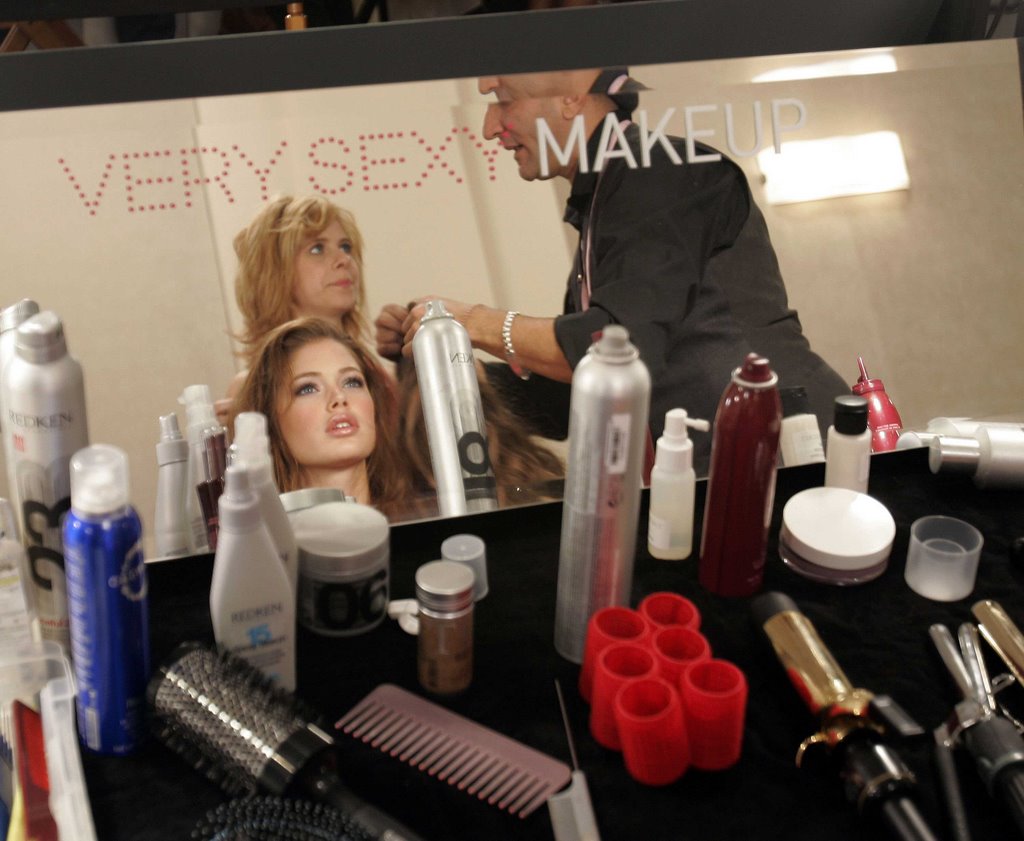
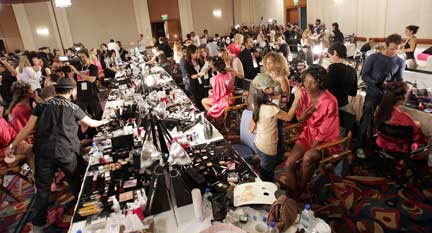
Backstage at Victoria's Secret Fashion Show


Yesterday I was allowed a few minutes backstage at the Victoria's Secret Fashion Show. Not exactly what it sounds like. More like an early morning media event where television and print media were allowed to take some photos and interview models that later that night would be taped for a TV show to be aired December 5th. The venue was at a ballroom of the Renaissance Hotel in Hollywood, a hotel attached to the Kodak Theater, the same place where they hold the Academy Awards every year. They tried to replicate an Academy Awards type of red carpet too.